| Correction: This just in from Steven Lewis:
Here is a .txt (click here to download) file with the revised and corrected offsets for the boats, along with offsets for a raised shear wider 15' version and a picture of the larger boat.

Steven Lewis
won our " Economy
River Cruiser" design contest a few years
ago. In the mean time he has been busy designing
all kinds of small, utility boats for amateur construction
and posting them on his website.
This design he designated as a Duckworks exclusive
- it is a free download
that is available nowhere else. Thanks Steven! |
Duckskiff is a 14 foot skiff I designed
for a buddy of mine named Tim that I work with. Tim is
an avid Duck hunter and wanted a fairly lightweight boat
but in nice quiet wood rather than noisy aluminum. He
also wanted something a little boatier than a Johnboat
styled craft. What I came up with for him is a 14 ft long
5 ft wide at the shear (45 inches wide at the bottom)
kind of semi-dory hull. I did this to make it an easier
and dryer proposition when pulling a large dog over the
side and back into the boat. The additional ultimate stability
of the 23° flare to the sides allows a lot of weight
to be right at the sides of the boat while at the same
time getting the shear lower to the water. He wanted to
be able to use his 7 hp motor to get around now with the
probability of upgrading to a higher hp later on. As the
hull was originally derived from a rowing style hull I
was playing with a few months previously I tweaked both
of them so that they were brother and sister similar and
decided to present them to you here. Enjoy…
Specifications for Motorized version:
LOA |
- |
14’ 3” |
Beam |
- |
5’ 2” (with trim) |
Depth at midships |
- |
18” |
Draft at design weight of 860
lbs |
- |
4.5” |
Approximate boat weight |
- |
180-220 lbs |
Motor |
- |
to 25hp |
 |
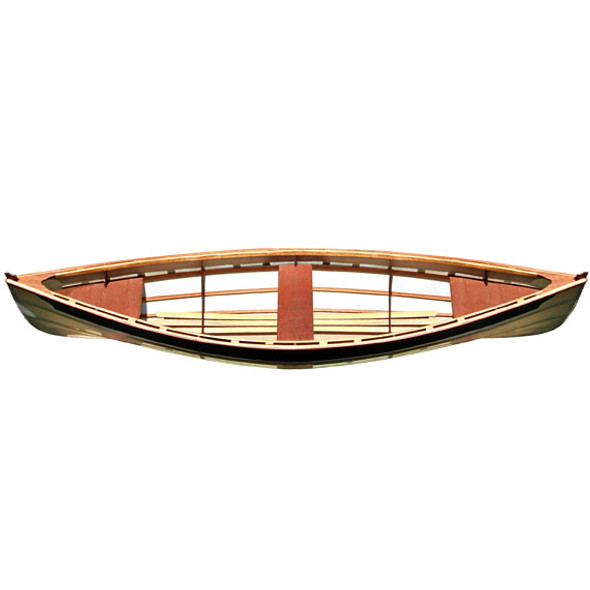
Motorized Version |
Specifications for Rowing version:
| LOA |
- |
14’ 1” |
Beam |
- |
5’ 2” |
Depth at midships |
- |
18” |
Draft at design weight of 600
lbs |
- |
4” |
Approximate boat weight |
- |
130-160 lbs |
 |
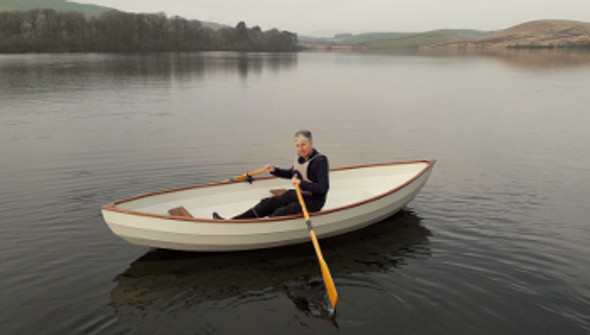
Rowing Version |
Introduction:
Using these instructions, along with the accompanying
sketches, drawings, illustrations, photos and tables,
you should be able to build either version of DuckSkiff14with
relative ease over the course of 2-6 weekends. The original
instructions were written for just the motorized version
but have been added to, amended to and revised in the
appropriate areas where the information or building instructions
differ for the rowing version. Please take the time to
read ALL of the information as better than 90% applies
to both forms of the boat and in both methods of construction.
The photos are not of this particular boat but are used
to illustrate what a certain method or outcome should
look like. Do not be thrown off by a Vee bottom or a differently
shaped hull but use it as a visualization of one possible
way of doing something. The Photos are also not all mine
but are courtesy of my many online friends in the various
forums and groups that I inhabit
Steven's
plans consist of 61 pages of diagrams, detailed
instructions, offsets, and even photographs. The
plans are free to download
and you can build as many as you wish. |
Bill of Materials:
1: Two sheets of 3/8” (Row) or 1/2”(Motor)
plywood or MDO (Medium Density Overlay) for the bottom
(Note: the longest life can be expected from marine grade
plywood and MDO…lesser grades can be expected to
have a shorter life span)
2: Two sheets of 1/4” (Row) or 3/8" (Row
or Motor) plywood or MDO for the sides
 |
Panel layout for
Motorized version. |
3: One sheet of 1/4" plywood for seat boxes (if
building them)
4: One sheet of 3/4” plywood or MDO for transom
and doubler and also knees and breasthook if not using
solid wood (required only on the motorized version). You
can use 3/8” ply for the transom on the rowing version
provided you add some framing t o stiffen it up a bit.
The knees and breasthook can be of 1x stock.
5: 12’ and 16’ lengths of 1x stock. The
amount will depend on the intended building method and
finishing. At a minimum you will need 2”- 3”
wide strips for the inner and outer wales, floor stringers,
bottom rub strips and cleats… plus additional 1
1/4” wide strips for Chine Logs if building that
way. You may also wish to use 1x stock for seat planks.
If you choose to space the gunnel you will need to factor
that in too. Sit down and calculate what you need by how
you are planning on building the boat. You should only
need the 16’ stock for the gunnels, but you can
get away with shorter stuff if you don’t mind joints.
All joints should be in the aft sections of the boat.
The better the quality of the wood the easier to finish
and the longer lasting.
The
Duckskiff plans have 18 detailed illustrations like
this one to guide the builder through the construction
process:
|
The plans
6: Stem piece: 28” long piece of 2”x3”
or 2”x4” fir or hardwood
7: A bag of 100 4” plastic wire ties or a roll
of copper wire for the Stitch and Glue version
8: Epoxy…the minimum amount of epoxy needed is
about 1 quart, for taping, gluing and filling on a boat
built with Chine Logs. Stitch and glue will require another
quart, as will glassing the bottom. If you wish to totally
seal the boat (not a bad idea at all)…you will probably
need all of the above and an additional quart…so
about 1 gallon of epoxy. I don’t recommend polyester
resin as it is not useful as a glue, isn’t really
waterproof in the amounts you would use and doesn’t
stick to wood nearly as well as epoxy does. To save some
on epoxy you can use a glue like PL Premium polyurethane
glue when gluing parts together, but it tends to foam
up so it doesn’t work so well as a sealer.
 |
Panel layout for
Rowing version |
7: Filler for the epoxy…I like wood flour mixed
with Cabosil (fumed silica…wear a dust mask) 2 lbs
of wood flour and ½ lb of Cabosil will do the trick
for Stitch and Glue, half that for Chine Log.
8: Fiberglass: Tape =10 yards for Chine Log, 25 yards
for Stitch and Glue Cloth= 50” width x 5 yards 4-6
oz cloth if you plan on glassing it the bottom.
9: Mixers, mixing containers, tongue depressors or shaped
applicators (for fillets) latex or plastic gloves, dust
masks, sandpaper, 3/4" Stainless screws (if leaving
them in) or drywall screws (if removing) Clamps (cheap
plastic ones are fine, or cut some 4”-6”schedule
40 PVC pipe into 1” slices and split one edge for
a really cheap clamp), primer and paint. Deck and porch
paint or any good exterior heavy duty paint is fine along
with a good primer, Painters plastic or plastic sheet
for covering windows (better).
 |
There are 18 photographs
in the downloadable PDF plans so there can be no
confusion about the instructions |
10: Tools: The absolute minimum I would want to get
by with is a circular saw and a power drill/driver for
power tools although if you are good, a jigsaw will do
the job. Hand tools include a tape measure, a square,
a small block plane, a small hand saw for trim work and
a screwdriver. An Orbital sander is a definite nice thing
to have when it comes to rounding the Chines over and
feathering the tape edges in. A table saw makes cutting
bevels on long pieces a snap too, so you might want to
borrow or rent one for a couple of hours and get all your
parts cut out ahead of time. If you don’t want to
use screws to hold things together…you will need
a bunch of clamps. Cheap spring clamps work most of the
time but you could probably use a few C (or G) clamps
for any tough stuff. You can also make cheap clamps out
of 6” Schedule 40 PVC pipe…just cut 1”-2”
slices of the pipe and then cut a slit in them so you
can open them up.
11: Batten: Personally I use a 1” x 1/8”
x 8’ strip of aluminum as a batten and I recommend
you do too, especially if you are building the Chine log
version. You can use a wider batten on the Stitch and
Glue version but you only have 1/2" space for your
batten and nails on each side when laying out the bottom
panel with the Chine log version.
Following is the outline of the building instructions:
- Step One Laying out the panels:
- Option One: Stitch and Glue Construction for both
versions:
- Option Two: Chine Log Construction.
- Step Two: The Stem Piece:
- Step Three: Assembly:
- Joining the panels for either version or method
of construction:
- Assembling the hull (both versions) Stitch and
glue method:
- Assembling the Hull Chine Log Method:
- Bracing pieces:
- Seating:
- Finishing the interior:
- Finishing the outside-Stitch and Glue method:
- Finishing the outside-Chine Log method:
- Painting:
- Powering:
List of Pictures and Illustrations:
• Panel shapes (Motor)
• Panel shapes (row)
• Frame Detail
• Plank Seat Detail
• Boxed in motor area
• Stitch, Fillet and Tape detail
• Non-spaced gunnel detail
• Spaced gunnel detail
• Center mold
• Chine log detail
• Knee detail
• Spreader measurement and marking detail
• Breasthook example
• Transom half layout detail
• Transom bevel detail
• Short shaft detail
• Long shaft detail
• Transom framing for rowing version detail
• Stem detail
• Squaring the hull detail
• Layout picture one
• Layout picture two
• Batten
• Fiberglass butt picture one
• Squaring the hull detail
• Layout picture one
• Layout picture two
• Batten
• Fiberglass butt picture one
• Fiberglass butt picture two
• Fillet on inside
• Smoothed fillet
• Tape on inside
• Stitching one
• Stitching two
• Knee, Butt block and box seat picture
• Another knee picture
• Boxed in Motor area
• Non spaced gunnel
• Spaced gunnel (plywood plank edge covered)
• Spaced gunnel (solid planking edge left exposed)
• Outside seams dry taped and stapled into place
• Outside hull with fiberglass
• Skeg picture
If you like the looks of anything you see here,
please feel free to download the free plans. Oh,
and thank Steven
while you are at it.
Click
HERE to download free plans for Duckskiff
|
|