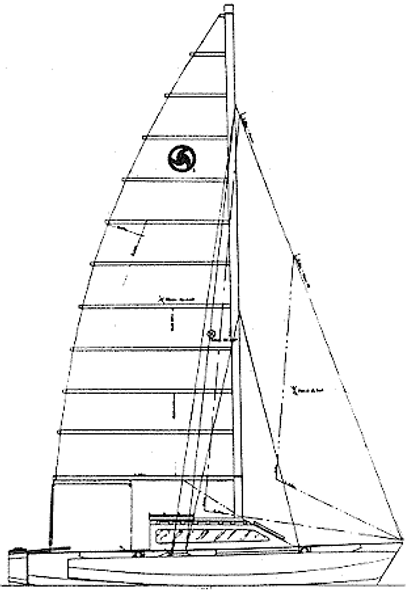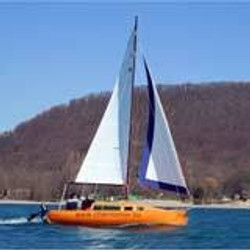
GIZMO, SAILING PROA, 20' X 8', 250 POUNDS
EMPTY
I'm finding out folks talk about proas
like they talk about sex. Most talk about it a lot more
than they do it. The ones who do it a lot don't talk about
it.
Gizmo was designed at the urging of
Craig O'Donnell who edits the Cheap
Pages. In there is section on proas. Like
most of you I have never actually seen a real proa but
I think it's good practice to do an unusual design once
in a while.
Proas don't tack through the wind as
would a normal sailboat. Instead they are symmetric about
their middle and to reverse direction you reconfigure
the rig to sail the other way and take off. What was your
stern is now your bow. Is that clear?? If you look at
the rig drawing shown above, Gizmo is rigged to sail from
right to left. But if the sail were dipped to point the
other way, she would sail just the same from left to right.
In the case of the lateen sail shown here you might also
just let the sail swing around the mast so it points the
other way. The balance float which is called an ama is
always on the windward side of the main hull. The advantage
of the proa is that, under certain conditions, the boat
can be very simple and fast. Essentially proas are sailing
canoes. The ama provides balance to a rig much larger
than can be carried by a normal canoe. With the ama "flying"
a bit over the water you have a very slim main hull being
pushed by a big rig with a crew sitting in comfort and
safety.
But getting this all to work is a challange.
Historical proas were ocean boats in the trade winds and
could take their time in tacking, if they ever had to.
They steered with a long oar over the current stern and
reset the sail with each tack. You can't do that solo
or in crowded waters. The rig shown might help having
two stout rudders that swing up either way in shallows.
The skipper locks one in the straight position and steers
with the other and can swap back and forth. I got the
idea from Phil Bolger. I don't know if it has ever been
tried for real. Phil intended it to steer with the bow
end rudder but I think it might steer with either end.
The loads on the aft rudder might be quite high so the
rudders are "balanced" quite a bit in that the
pivot axis is almost on the rudder's centerline and not
on its leading edge. These boats are always big experiments
and don't expect to get by without a lot of tinkering.
I think a proa is a very simple idea that is hard to deliver
properly if it must be single handed in crowded waters.

Gizmo is probably sufficient for two
adults and no more. Remember it is just a long narrow
canoe. I kept the total width at 8' for easy trailering
but you could widen it easily. The mast shown is unstayed
but is set up so that you can run stays form the masthead
to the ama for really hard sailing. The 94 square foot
sail looks small for a 20' boat, but big considering the
2' beam of the main hull. Commodore Monroe had something
like this in Florida a hundred years ago only 30' long
and heavy. It planed although he didn't use that word
because it hadn't been invented yet. I'm wondering if
it was the first planing boat?
Seven sheets of 1/4" plywood
build Gizmo with taped seams. No jigs or lofting.
|